
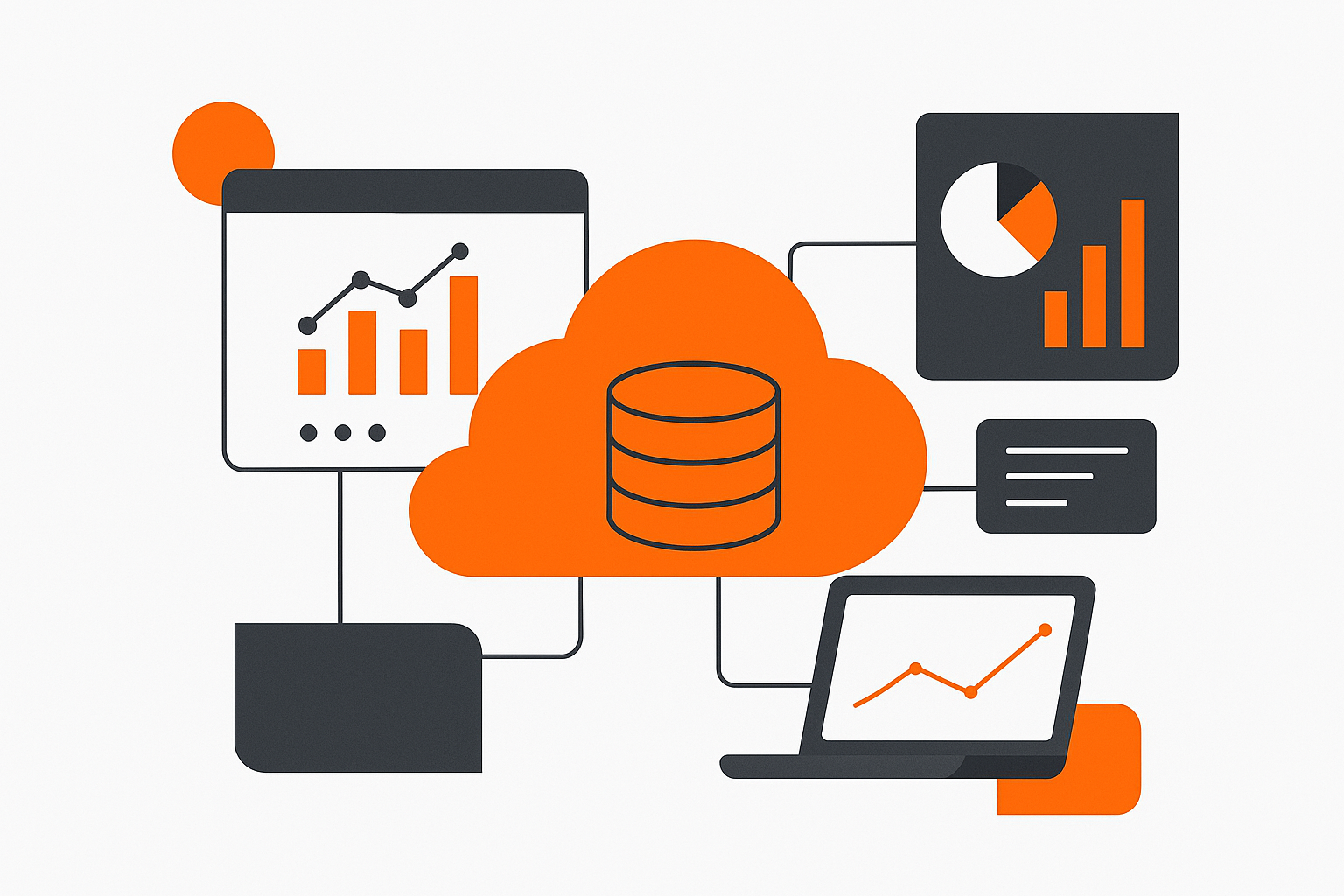
🌐 A New Era for Data Workflows
In today’s data-driven world, businesses need more than just analytics they need intelligence. AnalyticDB for MySQL, originally a high-performance cloud-native data warehouse, has transformed into a cutting-edge AI-powered data lakehouse. Built on Alibaba Cloud ApsaraDB, it now supports open lake formats like Paimon, Iceberg, Delta Lake, and Hudi, offering database-grade performance for massive-scale structured data.
But as AI workloads surge, traditional lakehouses hit their limits. AnalyticDB’s evolution addresses these challenges head-on bringing together BI analytics, machine learning, and multimodal data processing into one unified platform.
⚠️ Why Traditional Lakehouses Fall Short for AI
Legacy lakehouses were designed for SQL-centric analytics and ETL. But AI workloads introduce new demands that expose critical gaps:
🧠 Unstructured & Vector Data Challenges
Metadata and raw files are stored separately, causing consistency issues and inefficient access. Vector search? Not natively supported.
🐢 I/O Bottlenecks
ML requires fast, small-batch random reads. Traditional lakehouses favor full scans great for JOINs, but slow for training loops.
🧩 Inefficient Resource Scheduling
AI pipelines juggle CPU and GPU tasks. Without coordinated scheduling, resources sit idle and throughput suffers.
🐍 Fragmented Python Ecosystem
Crossing from JVM-based SQL engines to Python ML frameworks adds serialization overhead and slows development.
🖼️ Complex Multimodal Management
Storing structured, unstructured, and vector data in silos complicates discovery, governance, and joint processing.
🧠 AnalyticDB’s AI-Native Lakehouse: What’s New?
To bridge the gap between BI and AI, AnalyticDB introduces two game-changing components:
🔧 Ray: Distributed AI Computing Made Easy
Ray is an open-source framework for scaling Python-based AI workloads across clusters. It includes modules like:
- Ray Tune for hyperparameter tuning
- Ray Train for distributed training
- Ray Serve for model deployment
AnalyticDB Ray is a fully managed service that integrates Ray into the lakehouse—offering seamless scheduling, GPU acceleration, and zero cluster maintenance.
🗂️ Lance: The Multimodal Storage Format for AI
Lance is a high-performance storage format built on Apache Arrow, optimized for:
- 🔍 Fast point lookups
- 🧭 Efficient vector search
- 🧬 Schema evolution without rewriting
- 🌐 Native integration with PyTorch and TensorFlow
Lance on AnalyticDB Lake Storage enables zero-copy reads and writes for multimodal datasets—images, text, audio, and embeddings all in one place.
🔄 Traditional vs AI-Powered Lakehouse: Feature Comparison
| Feature | 🏛️ Traditional Lakehouse | 🤖 AI-Powered Lakehouse |
|---|---|---|
| Use Cases | BI, ETL, SQL analytics | BI + AI (RAG, RL, fine-tuning, inference) |
| Users | Data analysts, engineers | AI developers, ML scientists |
| Data Types | Structured, semi-structured | Structured + unstructured + vectors |
| Access Patterns | Full scans, batch reads | Random access, small-batch reads |
| Workloads | SQL, DataFrames, CPU-centric | Python-native, GPU-optimized |
| AI/ML Support | External tools required | Built-in ML, inference, deployment |
🛠️ Building AI Pipelines with Ray + Lance
⚡ Zero ETL with APS
AnalyticDB’s Pipeline Service (APS) automates data ingestion and transformation:
- Detects new files (e.g., videos)
- Extracts frames and generates embeddings
- Converts multimodal data into Lance format
- Supports custom operators and external services like Bailian
This enables zero-ETL pipelines from raw data to AI-ready formats no manual coding required.
🧪 Real-World Use Cases
🖼️ Mixed Image + Text Storage
Scenario: Store images alongside descriptions, labels, and IDs.
# Spark merges image + text
df = spark.read(...)
df.write.format("lance").save("lakehouse_path")
Benefits:
- Unified storage improves consistency
- Reduces I/O overhead 2–4× faster than Parquet
- Alt text: “Image thumbnail stored with metadata in Lance format”
🏷️ Image Tagging + Model Fine-Tuning
Scenario: Add descriptive tags to images and fine-tune models.
# Ray Serve deploys tagging model
# Lance stores updated dataset with new tags
Benefits:
- Schema evolution adds columns without rewriting files
- 3× performance boost over Parquet
- One-stop pipeline for tagging + fine-tuning
🚗 Autonomous Vehicle Data Processing
Scenario: Process petabytes of multimodal sensor data.
Workflow:
- Ray Pipeline segments and tags video
- Tagged data stored in Lance
- Airflow triggers secondary ML tasks
Benefits:
- GPU utilization exceeds 90%
- Task throughput hits 400+ tasks/sec
- Scales linearly with added resources
🧪 Sample Code: PyTorch + Lance
from lance import dataset
import torch

ds = dataset("s3://mybucket/vehicles.lance")
for batch in ds.to_torch(batch_size=32, shuffle=True):
    images, labels = batch["image"], batch["label"]
    # images are zero-copy tensors usable in PyTorch training loop
    ...
🌟 Toward Zero-Ops Multimodal Lakes
AnalyticDB is building toward a zero-ops future automated ingestion, metadata management, and compaction for Lance-based data. The goal: make multimodal datasets discoverable, manageable, and AI-ready from day one.
🔗 Learn More
Explore AnalyticDB for MySQL and discover how unified BI + AI workflows can transform your data strategy.
